NANCY CUNARD - REBEL HEIRESS
Updated: Aug 21, 2021
The controversial women who abandoned her privileges of a heiress to devote her life to fight against racism and fascism.

PROFILE

Name: Nancy Cunard
Born: 10 March 1896
Astrology: Pisces
Nationality: British
Residence: London, Paris, Normandy, Harlem- New York, Spain,
Occupation: Heiress, Muse, Publisher, Poet, Journalist, Social Activist
Romance : Mariage in 1916 to wounded veteran, quickly divorced 20 months later. Dated Modernist poet Ezra Pound in 1921, Dada leader Tristan Tzara in 1924, Surrealist poet Louis Aragon from 1926-28. She had several affairs with prominent writers and visionary artists, which she also served as muse for.
In 1928, she fell in love with jazz pianist Henry
Crowder. This relationship caused a scandal and the disapproval of her mother lead to her disinheritance.
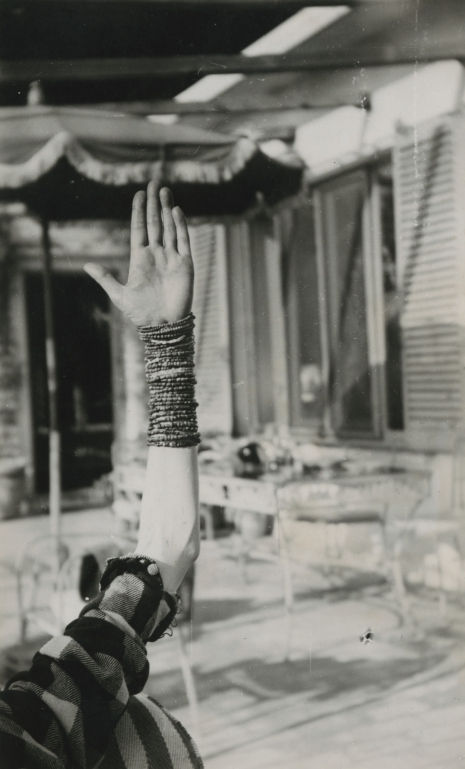
Style Signature: Influenced by African culture, she wore stacks of bangles made of wood, ivory and bone which became her trademark. She was one of the initiators in London to wear the 20's shingles hairstyle. Dark kohl rimmed eyes. Dressed in Paul Poiret, Chanel and Schiaparelli. Caused an outrage when wore her large African statement accessories.
Death: March 17, 1965 / March 16, 1965, Paris, France
Famous for / How she is Remembered :
MUSE
MUSE TO ARTIST AND WRITERS
Involved in the Dada, literary Modernism, and Surrealism.
She became muse to legendary artists and distinguished writers.
Immortalized through these photographs, sculpture, paintings and literature
THE PHOTOGRAPHERS
MAN RAY


CECIL BEATON

At the National Portrait Gallery

CURTIS MOFFAT


At the V&A Museum

Sonia Delaunay coat
BARBARA KER-SEYMER

Barbara Ker-Seymer photographer her posed in front of a tiger skin, spotted fur at her neck and a veil across her blazing eyes.
PAINTINGS / DRAWINGS
ALVARO GUEVARA

Part of the collection of National Gallery of Victoria, Melbourne
WYNDHAM LEWIS

OSKAR KOKOSCHKA

AMBROSE MCEVOY

JOHN BANTING

*** add the photographsn from tate here?
DAVID LEVINE

Sketch for The New York Review
THE SCULPTURE
BRANCUSI
“Everything about the way she behaved,” he once said, “showed how truly sophisticated she was for her day.” Brancusi

La jeune fille sophistiquée (Portrait de Nancy Cunard), a unique sculpture by Brancusi was sold at Christie's New York in May 2018 for a record for the artist at $71 Million.
In La jeune fille sophistiquée (Portrait de Nancy Cunard), Brancusi’s purity of line renders the cool beauty of Nancy Cunard, who was a major patron of artists and writers in Paris between the wars. Cunard counted Marcel Duchamp, Ezra Pound and James Joyce among her circle, and it was in this context that she first encountered Brancusi in 1923.
The meeting came about through the Dada poet Tristan Tzara, one of her many paramours. The iconoclastic heiress, who openly flouted sexual, racial and class boundaries, struck Brancusi as the very embodiment of the liberated Twenties — a figure of and for the moment. ‘Everything about the way she behaved,’ he recalled, ‘showed how truly sophisticated she was for her day.’
Cunard never posed for Brancusi, and in fact was unaware until many years later that he had sculpted a figure that bore her name. However, with superbly distilled volumes, the artist succeeded in capturing Cunard’s elegance and stylised presentation, creating a precise, individualised characterisation that simultaneously arrives at a universal, essential form.
Extract from Christies

POETS
MINA LOY
Cunard later became Mina Loy’s muse in her poem entitled “Nancy Cunard,” which mentions George Moore by name and highlights Cunard’s “lone fragility/ of mythological queens” (lines 13-14), and praises her storied beauty (Lost Lunar Baedeker).
Sourced from Mina Loy


WRITERS
Michael Arlen
Michael Arlen notoriously based his leading lady Iris Storm on Nancy Cunard.

The Green Hat
By Michael Arlen
Published 1924
The Green Hat perfectly reflects the atmosphere of the 1920s—the post-war fashion for verbal smartness, youthful cynicism, and the spirit of rebellion of the "bright young things" of Mayfair. Iris Storm, femme fatale, races around London and Europe in her yellow Hispano-Suiza surrounded by romantic intrigue, but beneath the glamour she is destined to be a tragic heroine. A perfect synecdoche, in fact: as the hat is to the woman, so the words of the title are to an entire literary style. The success of the novel when it was first published in 1924 led to its adaptation for the screen, with Greta Garbo starring as Iris Storm.
Sourced Good Reads
First published in 1924 and a massive best-seller, this is ostensibly the story of a wild young widow with a shady past and a taste for fast cars and adultery, set mostly in Mayfair just as the Twenties began to roar. Arlen muses on the English upper classes, still dazed by the First World War, and regales the reader with philosophical asides and reactions on the nature of women, drunkenness, doctors who specialize in diseases of the rich, the management of nightclubs, and much more. Finally delivering a shattering ending to this quest for the true nature of his heroine.
Aldous Huxley
Nancy Cunard is notably recognized as the muse for the character Lucy Tantamount in Point Counter Point.

Point Counter Point By Aldous Huxley Published in 1928
Aldous Huxley's lifelong concern with the dichotomy between passion and reason finds its fullest expression both thematically and formally in his masterpiece Point Counter Point. By presenting a vision of life in which diverse aspects of experience are observed simultaneously, Huxley characterizes the symptoms of "the disease of the modern man" in the manner of a composer--themes and characters are repeated, altered slightly, and played off one another in a tone that is at once critical and sympathetic.
First published in 1928, Huxley's satiric view of intellectual life in the '20s is populated with characters based on such celebrities as D.H. Lawrence, Katherine Mansfield, Nancy Cunard, and John Middleton Murry, as well as Huxley himself. Source Good Reads
When it was published in 1928, Point Counter Point no doubt shocked its readers with frank depictions of infidelity, sexuality, and the highbrow high jinks of Aldous Huxley's arty characters. What's truly remarkable, however, is how his novel continues to shock today. True, we may hardly lift an eyebrow at poor Marjorie Carling leaving her husband to live in sin with--and get pregnant by--her lover Walter
Bidlake. And the sexual exploits of Lady Edward Tantamount or her daughter, Lucy, seem quite in keeping with the behavior expected of such exalted persons by readers inured to the exploits of the British Royals. If the varieties of sexual experience on display in Huxley's novel seem tame by current standards, his clear-eyed dissection of the motives behind them are thrillingly fresh--and his commentaries on everything from politics to ecology sometimes chillingly prescient. Take for example, the wisdom of amateur biologist Lord Edward Tantamount on the subject of non-renewable resources:

FASHION
Paul Poiret, Elsa Schiaparelli et Coco Chanel




This striking wrist cuff, a masterpiece of French 20th Century jewelry, shows the formative influence of African art and artifacts on modernist design. It was designed in the African style by Boucheron and made for them in May of 1931 by the atelier Sellier-Dumont in Paris. The bracelet was exhibited by Boucheron at the Exposition Coloniale Internationale in Paris the same year, along with a modernist necklace composed of the same materials. Both the strong barbaric armlet form of the bracelet and the use of specifc materials pointed to the richness of colonial culture and resources. The malachite came from the Congo, a French colony, and the polished gold beads told of Africa’s gold resources, its alluvial deposits and the cultural significance of Ashanti gold. The purpurine, the dark reddish purple brilliant opaque glass, seems most likely to reference the Venetian glass beads so widely traded across Africa since the 16th Century.
The bracelet further tells of the cultural signifcance, underlying meanings and spirituality of African ornaments. Jewelry in Africa was rarely purely ornamental, instead worn for very specific reasons including tribal identification, status, protection from evil spirits and various rituals. Bangles and ankle bangles were particularly important and ubiquitous, often worn as fighting bangles by boys and women, and the style quickly spread to Europe. By the 1930s, socialite Nancy Cunard was famed for wearing armfuls of original African ivory fighting bangles.
The aim was to show the rich cultural diversity and precious resources of the French colonies, although other countries also participated to show their colonial riches. Boucheron’s display in the jewelry pavilion, amongst other Parisian jewelers such as Dusausoy, was greeted with great critical acclaim. A 1931 Vogue article on Parisian jewelry noted, “Boucheron has made a whole-hearted response to the Colonial Exhibition that has aroused everyone’s interest and delight.” The feature goes on to describe Boucheron’s use of “frankly barbaric” materials such as the teeth and claws of “savage beasts, which were set into soft and primitive-looking yellow gold” to create their jeweled masterpieces.
https://www.sothebys.com/en/auctions/2013/magnificent-jewels-n09054/magnificent-jewels/2013/11/an-iconic-modernist-.html

GUCCI COLLECTION
https://www.nytimes.com/2011/09/22/fashion/22iht-rgucci22.html
EDERM COLLECTION
Spotting an image of socialite and political activist Nancy Cunard at the Cecil Beaton: Bright Young Things exhibition earlier this year, Moralıoğlu used Cunard as his muse for the collection, a role she had played many times before for the likes of Ernest Hemingway, Man Ray and Wyndham Lewis.
“She was an anti-fascist who fought against racism...a journalist, poet, muse; completely ahead of her time.” Erdem Moralioglu is speaking about Nancy Cunard, the heiress to the cruise line, whose portrait he came across with Robin Muir at the “Cecil Beaton: Bright Young Things” exhibition, now hanging locked in at London’s National Portrait Gallery.
In the conclusion of Erdem’s press release, Cunard’s influence becomes a generalized characterization of a muse, a projection, perhaps, onto the kind of women who will buy his clothes. “Until recently, her nobility defined her identity; now she is defined by her principles, not just her privilege.”
ROMANCES


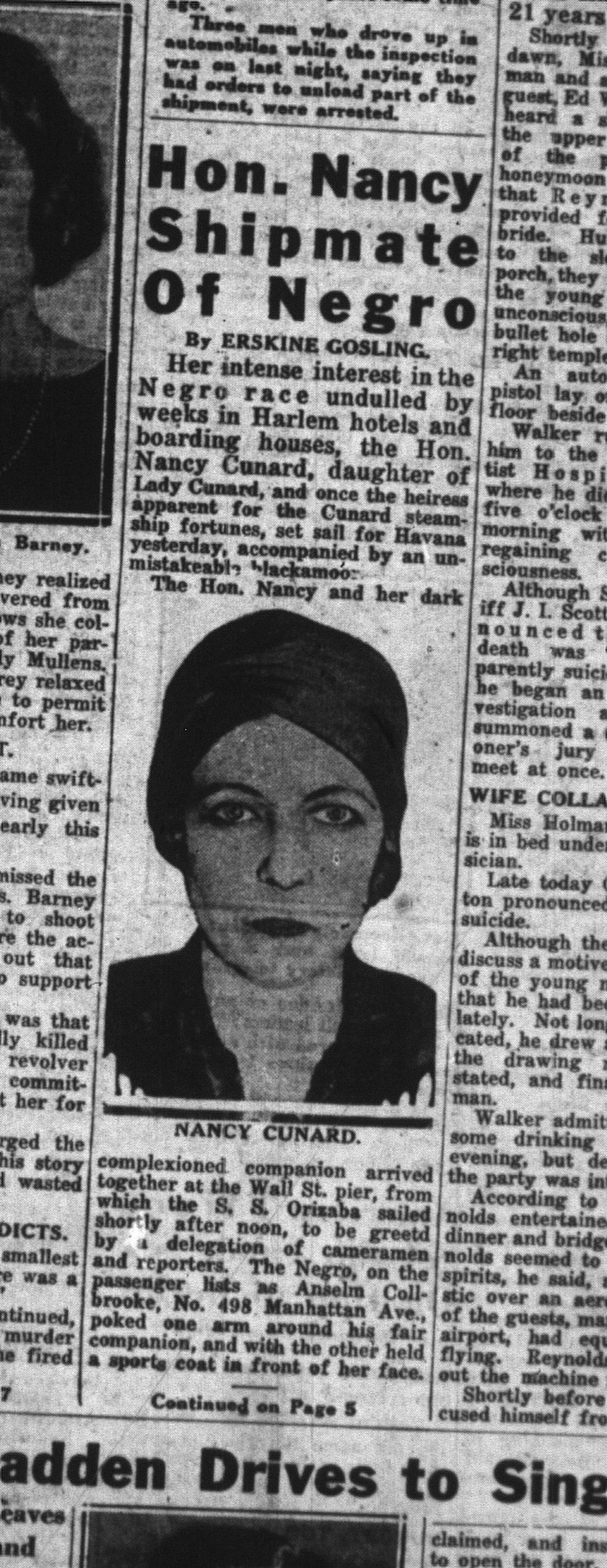


CAREER
Poetry books
Outlaws published in 1921
Sublunary published in 1923
Parallax published by Virgina Woolf’s esteemed Hogarth Press in 1925. This long poem was largely criticized as a derivative of T.S Eliot’s Wasteland.
Contributed in the first instalment of Wheels


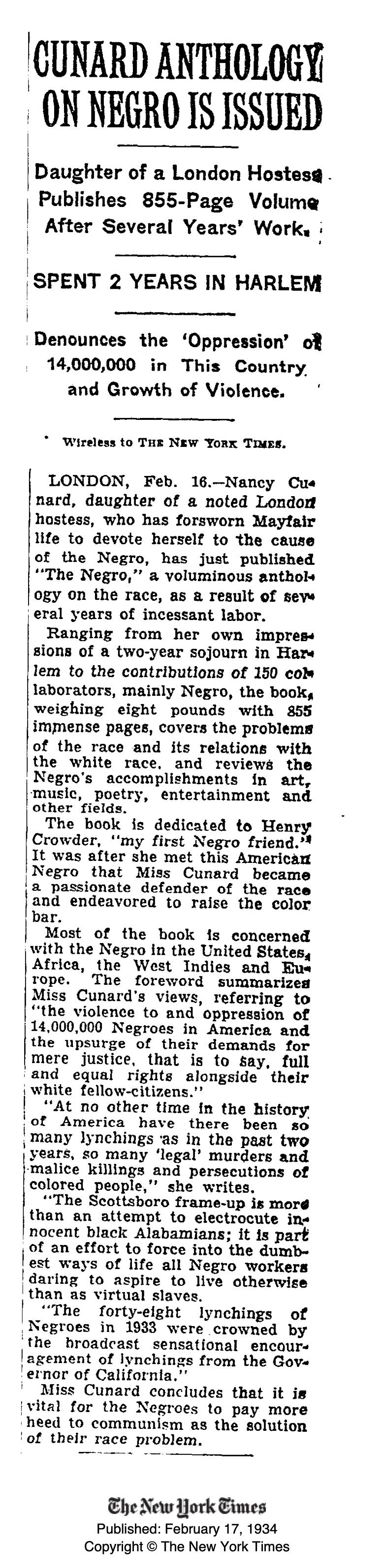
TRAGIC ENDING
NEW YORK TIMES OBITUARY

“To be in the presence of Nancy was more like coming to grips with a force of nature...” said the writer Solita Solano. “It was impossible for her to work quietly for the rights of man; Nancy functioned best in a state of fury in which, in order to defend, she attacked every windmill in a landscape of windmills.”writer Solita Solano
THE BOOKS
MENTIONED IN THESE BOOKS
Being Geniuses Together
By Kay Boyle & Robert McAlmon Published in


Paris is Burning
ByJanet Flannery (Genet) Published in


Memoirs
by Pablo Neruda
Nobel Prize winner


Comments